· Last updated:
Italian Traffic Signs: Complete Guide
A complete guide to understanding Italian road signs for expats. Master the shapes and colors of Danger, Prohibition, and Obligation signs for your Patente B exam.
Driving in Italy is thrilling, but its roads are governed by hundreds of specific signs. Whether you are driving through a historic ZTL (Limited Traffic Zone) or studying for your theory exam, misunderstanding a sign can cost you a fine—or an exam failure. In this guide, we break down the three most critical categories of Italian traffic signs: Danger, Prohibition, and Obligation.
Italian Traffic Signs: Complete Guide
Chapters 2, 3, and 4 of the Italian Highway Code (Codice della Strada) are entirely dedicated to vertical road signs. For anyone following a 3-month Patente B study plan, mastering the visual language of these shapes is your first major milestone.
1. Danger Signs (Segnali di Pericolo)
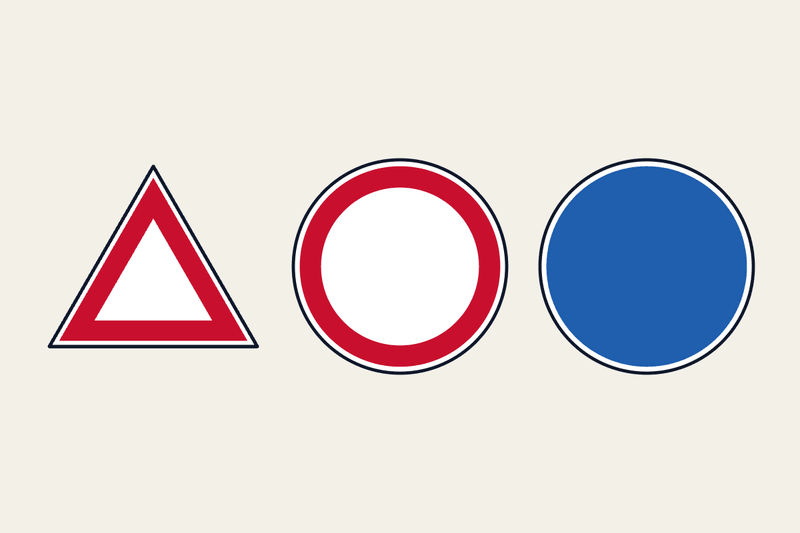
Visual Rule: Triangular shape, pointing upwards, with a red border and a white background.
Danger signs warn you of an upcoming hazard, usually placed 150 meters before the danger itself to give you time to slow down.
- Common Examples: Uneven road (strada deformata), dangerous curves (curva pericolosa), or pedestrian crossing (attraversamento pedonale).
- Exam Tip: If a theory question asks if a danger sign requires you to slow down, the answer is almost always Vero (True).
2. Prohibition Signs (Segnali di Divieto)
Visual Rule: Circular shape with a red border and a white background.
Prohibition signs tell you what you are not allowed to do.
- Common Examples: Speed limits, no overtaking (divieto di sorpasso), and no entry (senso vietato).
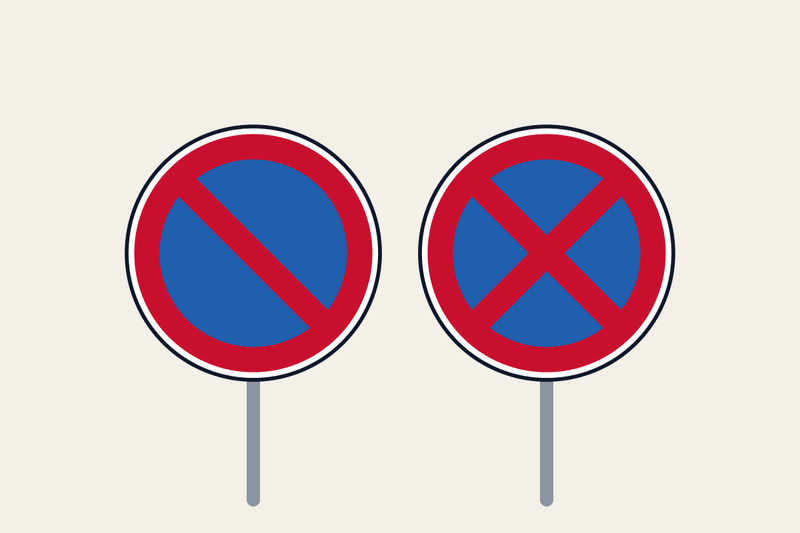
- The Exceptions: The "Stop" sign is an octagon, and the "No Parking" (divieto di sosta) sign has a blue background with a red slash. Knowing the difference between sosta and fermata is a classic trap on the Patente B exam.
3. Obligation Signs (Segnali di Obbligo)
Visual Rule: Circular shape with a solid blue background and white symbols.
Obligation signs tell you exactly what you must do. They do not suggest; they command.
- Common Examples: Mandatory direction ahead (direzione obbligatoria), minimum speed limit, or mandatory snow chains.
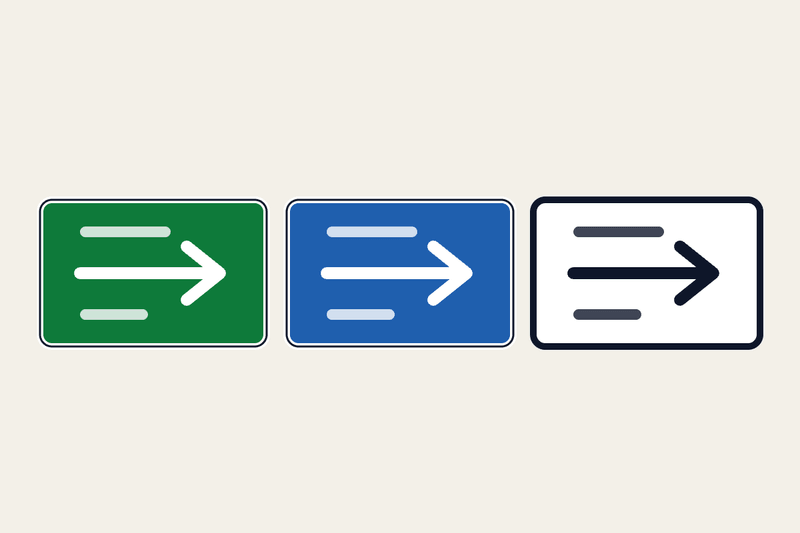
- Exam Tip: Do not confuse a blue circular sign (you must go this way) with a blue square sign (which just gives you general information or directions).
The Colour System
Red (Warning and Prohibition)
Red-bordered triangles (segnali di pericolo): Warning signs — triangular, white background, red border. Alert you to hazards ahead (bend, junction, school, pedestrians, level crossing). No instruction — they inform, you decide how to react.
Your license is waiting.
Chapter 1 is completely free. No credit card. Cancel anytime. Just you and the road.


Red-bordered circles (segnali di divieto): Prohibition signs — circular, white or blue background, red border (often with a red diagonal bar). Tell you what you CANNOT do: no entry, speed limit, no overtaking, no parking.
Red octagon: STOP — the only octagonal sign on Italian roads. Mandatory complete stop.
Blue (Obligation and Extra-Urban Direction Signs)
Blue circles (segnali di obbligo): Mandatory signs — blue circle, white symbol. Tell you what you MUST do: turn right, go straight, minimum speed, use snow chains or winter tyres.
Blue direction signs: Direction signs on extra-urban roads (outside towns), or leading to them — destinations and distances on roads that are not motorways.
Green (Motorways)
Green direction signs: Direction signs on motorways (autostrade), or leading to a motorway — motorway junctions, exits and the destinations they serve.
White (Urban Direction Signs)
White backgrounds: Direction signs within urban areas — local destinations, street names, city centre directions within towns.
Yellow (Temporary Signs)
Yellow background: Temporary signs — for example roadworks and diversions.
Brown (Tourism)
Brown backgrounds: Tourist and cultural interest signs — museums, parks, monuments, beaches, camping.
Shape Summary
| Shape | Category |
|---|---|
| Triangle (point up) | Warning (danger ahead) |
| Circle | Prohibition or obligation |
| Octagon | Stop |
| Inverted triangle | Give way |
| Rectangle/Square | Information |
The Most Common Exam Mistakes
- Confusing warning triangles with prohibition circles — both have red but different shapes
- Missing the distinction between temporary (yellow) and permanent signs
- Misreading the no-overtaking sign (two cars, one red) vs. end of no-overtaking (same but crossed out)
- Forgetting that blue circles are obligations (what you MUST do), not prohibitions
Frequently Asked Questions
Q: What does a white circle with a red border and blank inside mean?
A: This is the "Transit Prohibited" (transito vietato) sign. It means no vehicles can enter from either direction.
Q: How do I memorize all of these for the exam?
A: Group them by shape and color first. Once you know the category, the symbols usually make logical sense. You will master them automatically with smart educational system inside the Driving Freedom App.
For country-specific guides covering how these signs relate to your exam registration process, see: Iran · India · Pakistan · Bangladesh
Ready to test your sign knowledge? Start practicing today →.
Your license is waiting.
Chapter 1 is completely free. No credit card. Cancel anytime. Just you and the road.

Country guides
Codice della Strada
Read next